


We asked the publishing professionals we work with to share their favorite tools. Here are the 21 management tools they recommended unprompted, the ones they would tell their peers to use.
A quick word on scope first: this selection isn't about working on the text itself. You won't find proofreading, rewriting or manuscript layout software here. These are business management tools built for, or well suited to, publishing houses.
Where do these favorites come from?
For the management toolkit for book publishers in 2026, we mapped more than 50 solutions across 11 tool families. As we talked with publishers of every size, some names kept coming up. Those are the tools that earned our Publishers' Favorite badge.
For each tool, we note whether it uses artificial intelligence and where it sits on price, from € (affordable) to €€€ (premium, often quote-based). Many B2B publishing tools don't publish their pricing, so treat this rating as a guide: it's estimated from publicly available prices and listed customers.
Publishers' favorites by tool type
Here are the 21 tools that the publishers we spoke to recommended without being asked.
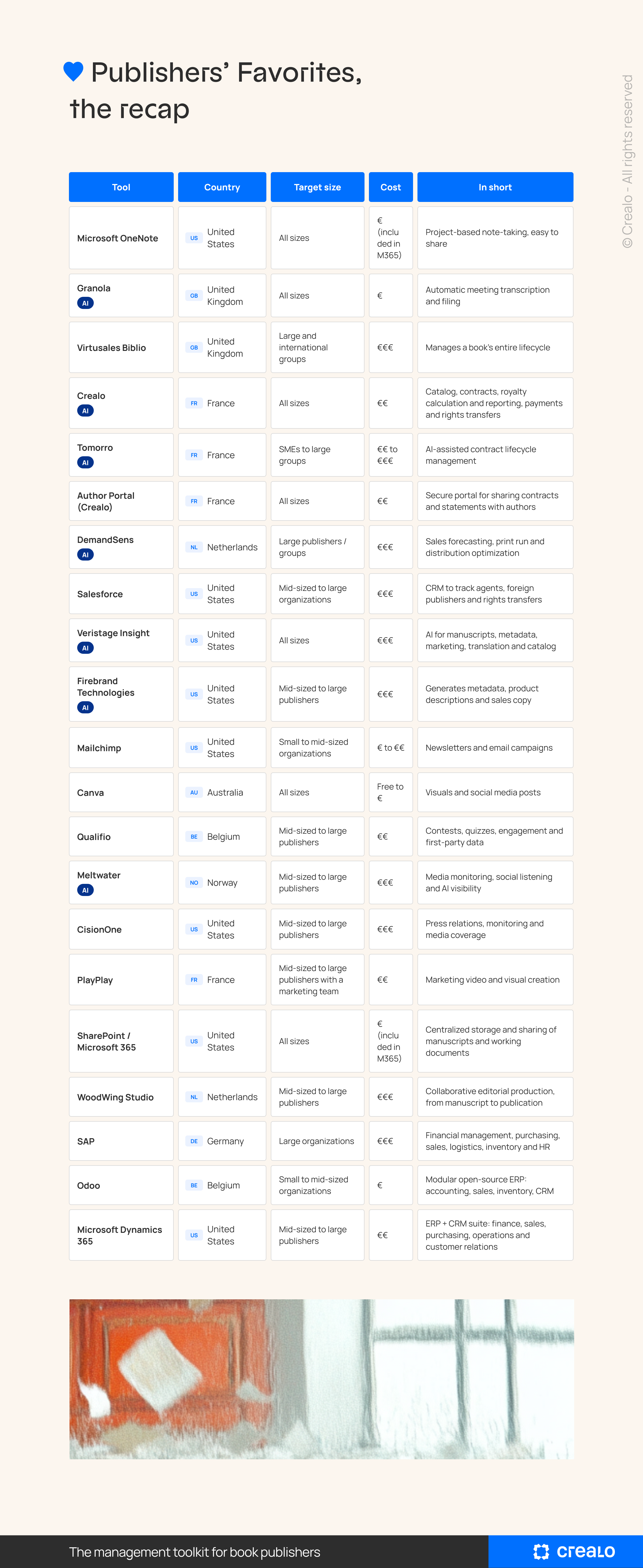
Key: indicative cost. € = affordable, €€ = mid-range, €€€ = premium, often quote-based.
Explore all these tools in detail:
Organization and project management
Granola
Automatic transcription and summaries of your editorial meetings. Granola transcribes meetings with impressive accuracy and files them away in folders. You can even ask questions about your notes. Think of it as a personal assistant: no more writing up minutes, and every past meeting is neatly organized and easy to find.
Microsoft OneNote
Microsoft OneNote lets you organize your notes by project and share them with your team. You can add to-do lists and enrich your notes with tables and documents. If your publishing house already runs on Microsoft Office, it's a handy way to keep track of all your projects.
Editorial and catalog management
Virtusales Biblio
This tool came up again and again in our conversations with publishers. Virtusales Biblio is an editorial management solution that covers a book's entire lifecycle, from acquisition to publication.
With Biblio, you can:
- Estimate a title's profitability: forecast print runs, costs, revenue and sales.
- Manage co-editions and co-printings: split costs, organize print runs and handle purchase orders.
- Centralize metadata: manage and automatically distribute title information, notably via ONIX.
- Follow industry standards: support for BIC, BISAC, Thema and CBMC.
- Create product sheets and catalogs: generate and export title information as CSV or XML.
Biblio's strength: it brings together a wide range of processes across a book's lifecycle in a single tool, from assessing a publishing project all the way to sales and reprints.
Catalog Management, by Crealo
Crealo's Catalog Management module lets you browse your catalog and quickly find the data and metadata for each of your titles.
To add a book to Crealo, simply enter its ISBN or EAN-13. Key details such as the description, cover, price and format are then filled in and kept up to date automatically.
Contract management
Word to draft, an e-signature tool to sign, Excel to track deadlines: in many publishing houses, contracts still bounce from one tool to the next, with plenty of re-keying along the way.
A dedicated contract management tool can make signing publishing contracts simpler and more professional.
Contract Management, by Crealo
Crealo's Contract Management module is built specifically for book publishing contracts. It helps publishers automate contract management, royalty calculation and royalty reporting.
The platform centralizes all your publishing contracts. You can create custom templates, collaborate with legal and editorial teams, and have contracts signed electronically. Contract data such as royalty rates, escalators and specific terms feeds directly into royalty calculations at reporting time.
Tomorro
Tomorro is a French contract management solution that helps companies centralize and automate their entire contract lifecycle.
The platform streamlines every step of contract management, from drafting to e-signature.
With built-in artificial intelligence, Tomorro makes it easier to analyze contracts and automatically tracks deadlines, reducing the risk of missing one and saving time.
Unlike Crealo, it isn't designed specifically for publishing contracts, but it can still meet publishers' contract management needs.
Author relations
Author Portal, by Crealo
The Author Portal is a secure space where publishers can share all the key documents of the author-publisher relationship: publishing contracts and royalty statements. Authors can view their full statement history at any time, from their computer or phone.
With the Author Portal, you can:
- Easily send publishing contracts and royalty statements (publisher side)
- Keep all documents in one place (author side)
- Update personal details such as address or phone number directly in the portal
The Author Portal's strength: authors get secure, self-service access to their documents, while publishers save time sending out contracts and royalty statements.
Learn more about how the Author Portal strengthens communication with your rights holders.
Royalties
Royalty Accounting Manager, by Crealo
Based on your contracts and imported sales data, Crealo's Royalty Accounting Manager automates royalty calculation, generates royalty statements for your authors and prepares payments.
Publishers can run royalty reporting as often as they like: annually, twice a year or quarterly.
The platform also handles rights licensing, automates the calculation and gives authors a secure portal to view their contracts and royalty statements.
Crealo's strength: AI that works for your royalty management
With the AI agent built into Crealo, you can access the information you need instantly and query your data in plain language. Pull up every statement for a given payee, analyze your bestsellers by category, find every contract containing a specific clause, and much more.
Built right into the royalty management software, Crealo's AI takes the automation of publishing contracts and royalties even further.
Sales management and rights licensing
DemandSens (BearingPoint)
DemandSens is an AI platform that helps publishers forecast sales more accurately and fine-tune how many copies to print and distribute.
The tool analyzes sales and distribution data to produce highly granular forecasts, down to individual titles and points of sale. Publishers can anticipate demand more precisely, avoid overstock and returns, and reduce the risk of running out of stock.
For book publishers, DemandSens can help estimate sales for a new release, set a better-suited print run and optimize how copies are allocated across retailers.
DemandSens's strength: it uses AI to turn historical sales data into actionable forecasts, so you can make better decisions about print runs and distribution.
Salesforce
Some publishing houses use Salesforce as a CRM to track contacts and rights opportunities: foreign publishers, literary agents, prospects and ongoing negotiations.
Rights Transfer Management, by Crealo
Crealo's Rights Transfer Management module lets publishers centralize and track their rights licensing contracts by title, author, territory or partner publisher. A dashboard gives you the key contract details at a glance, such as territories covered and signature status.
The rights licensing platform also tracks deadlines and payments, with notifications to flag contracts up for renewal or partners to follow up with. Teams can generate invoices for each stage of a deal and check incoming statements against the contract terms.
Crealo's strength: it brings licensing contracts, deadlines, invoicing and payment tracking together in one tool, making it easier to manage licensed rights and cutting down on manual follow-up.
Metadata
Veristage Insight
Insight is an AI tool that helps publishers automate tasks based on the content of their manuscripts and catalog. Starting from a single book, Insight can proofread and prepare a manuscript for production, generate metadata and marketing copy, translate content or help create accessible EPUBs.
The platform also lets you query your entire catalog. Publishers can search for titles that match a theme or trend, or identify books with strong potential for rights licensing.
Insight's strength: an AI designed specifically for publishing, able to work from the full content of books and their metadata. It can support several teams, from editorial and marketing to production, sales and rights.
Good to know: Veristage states that content uploaded to Insight is not used to train AI models, and that its information security management system is ISO 27001 certified.
Firebrand Technologies (AI)
Firebrand Technologies' Eloquence on Demand helps you generate metadata, product descriptions and sales copy.
Marketing
Mailchimp
A tool for creating, sending and managing newsletters and email campaigns for your readers.
Canva
For creating visuals and social media posts. Canva makes it easy to get started with graphic design.
PlayPlay
PlayPlay is a video and visual creation platform that lets marketing and communications teams produce professional content easily, with no editing or design skills required.
With ready-made templates and AI features, publishers can create promotional videos for their books, social media content, animated covers or launch campaigns.
The platform also integrates generative AI technologies such as Veo and Nano Banana to generate and transform visual content directly within the tool.
PlayPlay's strength: an approach similar to Canva's but focused on video, so marketing teams can quickly and independently produce content to promote their books and authors.
Qualifio
A marketing platform for creating contests, quizzes, surveys and engagement campaigns to collect first-party data and build reader loyalty.
CisionOne
CisionOne is a press relations and media monitoring platform that helps communications teams and publicists track media coverage and run their PR campaigns from a single tool.
With CisionOne, you can:
- Track press coverage: spot mentions of an author, a book or a publishing house in the media.
- Monitor print media: find and centralize articles published in newspapers and magazines, which is especially useful for publicists in publishing.
- Centralize media monitoring: follow coverage in the press and across other media channels.
- Analyze media coverage: measure campaign results and identify which outlets are talking about a book or an author.
- Make PR work easier: automate some monitoring and tracking tasks, freeing up more time for building relationships with journalists.
CisionOne's strength: centralized press coverage, especially in print, which makes it easier for publicists to follow and measure the media impact of a book, an author or a publishing house.
Meltwater
Meltwater is a monitoring and analytics platform that helps marketing and communications teams track their brand's visibility and reputation in the media, on social networks and now in AI tools too.
With GenAI Lens, publishers can see how their house, imprints or competitors show up in answers from ChatGPT, Gemini, Claude, Perplexity or Copilot.
The tool also identifies the media outlets, journalists and sources that shape AI-generated answers, so you can adapt your content and PR strategy accordingly.
Meltwater's strength: it brings media monitoring, social listening and AI visibility tracking together in one place. For publishers, that means understanding not only what the media are saying, but also how their brand is picked up and presented by the new AI-powered search engines.
Storage and collaboration
SharePoint and Microsoft 365
SharePoint and Microsoft 365 let editorial teams centralize manuscripts and working documents in a shared space. Publishers can track the different versions of a text, share files with authors and collaborators, add comments and work together on the same document.
Microsoft 365 integrates with Word, Teams and OneDrive, making it easier to collaborate on manuscripts throughout the publishing process.
WoodWing Studio
An editorial production platform where editorial, design and production teams can work together on the same book, from manuscript to publication.
Content, files, versions and approval steps all live in one place. Teams can organize their workflow, track a book's progress and collaborate in real time, without endless email threads.
WoodWing Studio also lets you prepare multiple publication formats within the same workflow, including print and digital editions such as EPUB, from the same editorial content.
ERP
SAP
SAP is an ERP designed mainly for large organizations. It centralizes financial management, purchasing, sales, logistics, inventory and human resources. For a publishing house with high volumes or complex processes, SAP can serve as the backbone for managing financial and operational flows.
Odoo
Odoo is a modular, open-source ERP that covers a wide range of functions: accounting, invoicing, purchasing, sales, inventory, CRM and project management. Its modular design lets book publishers pick the building blocks they need and expand their management setup step by step.
Microsoft Dynamics 365
Microsoft Dynamics 365 is a management suite that combines ERP and CRM capabilities. It covers finance, sales, purchasing, operations and customer relations. Publishers can use it to centralize sales and financial data and connect different management processes within a single system.
What publishers' favorite tools reveal about how they work
Three trends stand out from these 21 favorites in how publishing houses choose their management tools.
AI is becoming part of publishers' everyday work
Seven of the 21 tools in our selection use AI. Far from replacing editorial work, it mainly addresses operational needs: transcribing meetings, forecasting sales, generating metadata or analyzing contracts. These are practical uses that save teams time on tasks that are often tedious.
To dig deeper, read about the limits of AI in publishing and our comparison of AI tools for publishers.
Publishers combine general-purpose tools with specialized solutions
Microsoft 365, Canva and Mailchimp sit alongside software built specifically for publishing. This mix reflects a pragmatic approach: rely on general-purpose tools for everyday needs, and choose industry-specific solutions for more specialized processes such as royalties, contracts and metadata.
Marketing has a big place among recommended tools
With six favorites, marketing is the most represented category in our selection. Content creation, email campaigns, press relations, media monitoring: publishers now have a wide range of solutions to promote their books and grow their visibility.
The bottom line: there's no perfect toolkit that fits every publishing house. The right choice depends above all on the size of your organization, your priorities and the tasks you want to simplify or automate.
Discover 50+ tools for your publishing house
Want to see the full selection? The management toolkit for book publishers in 2026 features more than 50 management tools across 11 families.
👉 Download the management toolkit for book publishers in 2026
💡 This selection will keep evolving as new tools emerge and publishing professionals share their recommendations. Using a tool you think deserves a spot? Let us know!
Further reading
- Why use contract management software as a book publisher?
- AI tools for book publishing: a comparative table to help you navigate
- 8 best practices for successful royalty reporting