


Royalty reporting is a demanding exercise. Yet, when properly prepared, it can become a true performance driver. Beyond mere legal compliance, integrating innovative practices into this process transforms it into a powerful engine of efficiency and reliability.
60% of tasks related to royalty reporting can be fully automated.
Beyond mere legal compliance, integrating innovative practices into this process transforms it into a powerful engine of efficiency and reliability.
These drivers are structured around four key dimensions:
- Automation
- Scalability and flexibility
- Regulatory compliance
- Analytics
The best practices for royalty reporting in 2026 presented here are based on these four pillars.
💡 If you would like to see how publishers have implemented them to optimize their royalty management, feel free to consult our guide : how to succeed in royalty reporting.
8 best practices for successful royalty reporting in 2026
1. Simplify your contract clauses
This tip, applied upstream of the reporting process, can cut the time spent on royalty reporting in half.
Of course, this lever is probably the least actionable in the short term, but the most impactful.
In publishing houses that work with a large number of authors, the diversity of contracts, each with its own specific terms, can quickly become a challenge during royalty reporting.
Each contract may define a different calculation base (e.g., net revenue, list price excluding tax, distributor sales, discounted revenue, etc.) and variable royalty rates depending on the format, the country of publication, or the territory of distribution.
The combination of all these parameters, amplified by the size of the catalog, can rapidly lead to hundreds of individual cases to manage, making the royalty reporting process cumbersome and time-consuming.
Here are three best practices to help simplify your contract clauses: :
- Map out all contract rules in a comprehensive matrix to identify common patterns
- Simplify contractual terms by standardizing clauses wherever possible to limit the number of special cases
- Simulate rule change to measure their financial impact before implementation
2. Plan price and rate changes at the start of each period
Price adjustments are part of a book’s natural life cycle. They can occur at various stages, and it’s rare to avoid them entirely. However, when changes are made sporadically throughout the year, they make reconciliation and calculations far more complex. Tracking becomes tedious and significantly increases the risk of errors.
During a financial audit, for example, reconciling historical pricing data is a frequent area of concern.
Anticipating and confirming these changes at the beginning of each period brings greater clarity. One period = one price.
This approach also ensures better traceability of historical prices and their associated sales.
For sales channels where prices fluctuate frequently, it’s best to base calculations on revenue.
If needed, you can display a weighted average price to authors for greater transparency. Contractual percentage changes are less common, but they also require careful monitoring.
Just like price adjustments, anticipating these updates at the start of the period makes royalty calculations much easier.
3. Integrate your sales data continuously, with a recurring multi-year frequency
Consistency is key.
Delaying sales entry until the end of the year increases the risk of errors and makes data verification much more time-consuming. Conversely, integrating sales data throughout the year strengthens the reliability of your calculations.
Ongoing monitoring of sales data and the royalties generated makes it possible to:
- Simplify checks: testing and validating formulas on smaller data sets helps minimize cumulative discrepancies
- Reduce anomalies: data entry errors, contract setup issues, and title or author mismatches are detected earlier
- Anticipate changes: new sales channels can be integrated into your processes and tested gradually, without waiting for the annual reporting cycle
4. Anticipate and gather information on your rights holders, catalog and contracts
Rights holders
Two key factors directly influence the amount paid to your authors and any associated deductions or contributions: their tax status and social security profile. Some rights holders don’t always know where to find this information or what their exact status is.
By anticipating these needs, you can ensure that your rights holder information is up to date and that each record contains all the necessary details ahead of your royalty reporting cycle.
You can set up a reminder workflow a few months before the start of the royalty reporting period, inviting authors/rights holders to update their details.
It’s also helpful to provide clear guidance explaining where to find the required information and how to supply the necessary documents.
💡 To avoid repeated follow-ups, Crealo provides an Author Portal that allows each author to update their personal information independently.
Authors receive a notification prompting them to review and update their data and, where applicable, upload any supporting documentation.
Catalog and contracts
Ensure you have a single source of truth, one central reference database for all your titles. This should serve as the foundation for every team involved.
Each work should be included in a centralized database that consolidates both commercial information (sales, stock, returns) and contractual data.
A clear and detailed catalog mapping is essential covering hardcover, paperback, digital, and audio editions, along with all associated metadata.
Even if you use multiple tools, make sure they all connect to this single reference database.
Finally, maintain a full change history to ensure data traceability.
5. Adapt your communication to address your authors’ specific questions
“Publishers often assume that the more detailed the royalty statements are, the more questions authors will have. In reality, it’s the opposite, a clear and detailed statement actually reduces confusion.”
Bastien Pragnère, Cutomer Sucess Manager, Crealo
This may seem obvious, but successful royalty reporting depends on complete and transparent statements.
⚠️ A consolidated royalty statement alone is not sufficient.
We’ve observed that some publishers only send a single consolidated statement covering all of an author’s titles which falls short of best practice.
When multiple works are covered under one agreement, publishers may aggregate royalties in a single report, but are expected to provide a breakdown by title within it.
It’s also helpful to identify the questions most frequently raised by your rights holders, so you can anticipate them and address them proactively, either directly within the royalty statement or through complementary resources such as dedicated FAQs, explanatory guides, or educational emails sent to contributors.
6. Check the consistency of stock movements
Make sure stock movements align with the sales recorded for the period.
- Theoretical sales: represent the volume that should result from recorded stock and inventory movements (print runs, returns, write-offs, and complimentary or non-royalty copies)
Theoretical sales = Opening stock (N-1) + Print runs (N) − Closing stock − Write-offs − Non-royalty copies
- Actual sales: are the sales that have been invoiced and recorded in accounting
Actual sales = Gross sales − Returns
Keep a detailed record of all print runs and reprints to justify any discrepancies.
Centralize all stock movements in a single file or dedicated tool, ideally shared with the relevant teams (editorial, accounting, etc.).
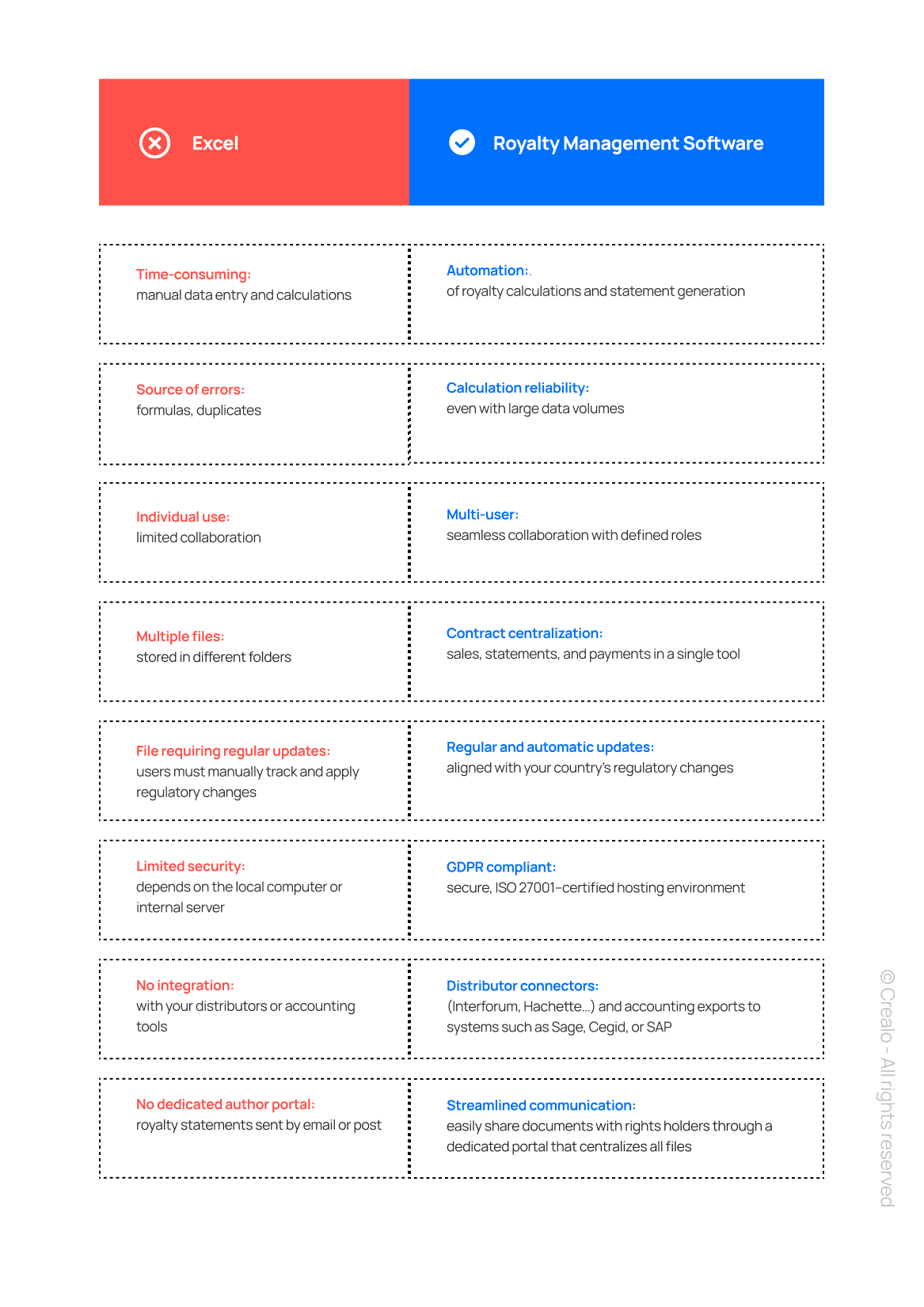
7. Avoid manual tasks and move beyond Excel
Many publishers still manage their royalties using Excel.
Even when best practices are applied, the risks remain high: an outdated file, a misplaced formula, or a missing data entry can be enough to distort an entire royalty statement in seconds.
The ideal approach is to rely on a dedicated solution that secures your processes and centralizes your data.
8. Learn from practices in related industries
When integrated within the Finance department, royalty management can benefit from innovations already transforming related areas such as invoice digitization, contract process optimization, and financial performance tracking.
Here are two examples:
OCR (Optical Character Recognition) technology automatically converts invoices, sales reports, or paper contracts into usable digital data. Already widely adopted in invoicing and accounting, it also brings strong value to royalty management systems. By extracting key information from rights licensing statements, OCR enables a more comprehensive analysis of title performance and royalty activity.
RPA (Robotic Process Automation) technology automates repetitive tasks such as data entry, bank reconciliation, and report generation. Already well established in management control and finance, RPA can also be applied to royalty management, for instance, by automating sales reconciliation and accelerating royalty reporting cycles.
Turning royalty reporting into a driver of sustainable performance
Successfully managing royalty reporting in 2026 is no longer just a matter of regulatory compliance. The nine best practices presented in this article show that effective royalty reporting is above all based on anticipation, data reliability, and process optimization.
Automation is the key. A royalty management tool not only makes it possible to centralize all data, but also to automate the many stages of the royalty reporting process.
If you would like to learn more about our royalty reporting solution, feel free to contact us.
Our teams will be happy to introduce you to Crealo.